What you get
What is delivered, and in what form.
A film is a set of files, a set of promises about them, and a plain answer to the question of what happens if something has to be shot again. This page is all three, so the handover holds no surprises.
The film itself
One master, finished properly
The master is the full film at the agreed length, graded, mixed and captioned, in the widescreen ratio it was shot for. Everything else on this page is cut from it.
| Ratio and size | Widescreen, sixteen by nine. Delivered at ultra-high definition (3840 by 2160 pixels) as standard, with a full-HD copy alongside for anything that cannot play the larger file. |
|---|---|
| Grade | Colour graded from the grey card shot in each light, so the floor looks like the floor and skin looks like skin. No colour cast, no filter looks. |
| Sound | Mixed in stereo from the sound bed, the lav mic and any spot effects recorded on the day. Delivered with and without the music bed, and a third version with the voice only, so you can re-mix later. |
| Captions | Two versions: one with captions burnt in for silent playback, one clean, plus a separate caption file you can load into any player. |
Shorter versions
Every ratio you asked for
Cut-downs are made from the master in the ratios agreed at the brief. The usual set is vertical (nine by sixteen), square (one by one) and widescreen, at fifteen, thirty and sixty seconds, though we will make any length a channel needs. Each one is re-framed by hand rather than cropped by rule: the subject stays where the eye expects it, and a title or caption never sits under the interface of the feed it will play in.
Every cut-down carries burnt-in captions, because most of them will play with the sound off. Each also arrives with a poster frame — a still, graded, chosen to work as the first thing seen.
Captions
Captions are written from the interview and checked against your own spelling of product names, place names and people's names as you write them, not as a machine guesses them. Captions in a second language are quoted separately.
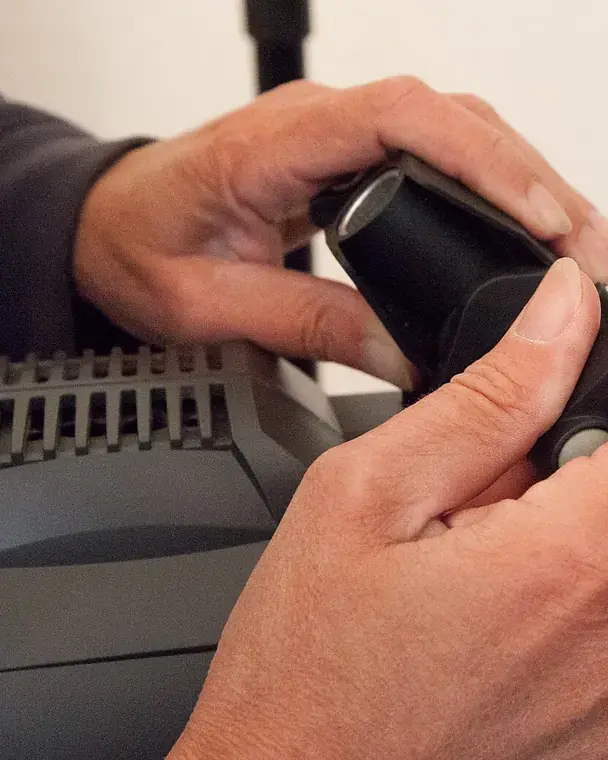
Tilt locked off before the take
Format and route
How the files reach you
Everything is delivered as a folder over a download link sent to the address on the brief. The link stays live for a stated window — long enough to copy the folder twice, which is what we ask you to do. If you would rather have a drive posted, say so on the brief and one is sent recorded delivery.
- Everyday files: the master and every cut-down as a widely playable video file, which loads into any player, editor or social platform without conversion.
- Archive master: a high-bitrate version of the master, for broadcast use or for re-editing years later, on request.
- Stills: a set of graded frame grabs from the master, chosen for use on a website or in print.
- Caption files for the master and each cut-down.
- A one-page note listing every file, its length, its ratio and its purpose, so whoever inherits the folder in three years knows what it holds.
What we keep, and for how long
The rushes and the edit project are kept on two drives for a year from handover, so a re-cut or a further cut-down can be made without a return visit. After the year they are deleted, unless you ask in writing for a longer period, which we will agree in writing. The master itself we keep as a reference copy for two years and then delete. Nothing is shown to anyone outside the crew without asking you first.
Revisions
The first cut comes back within the agreed number of weeks. You give notes once, as a single list, and we conform, grade and mix from that list. A second list is usually small and is folded in; a third round is quoted as further editing time, because by then the film has changed shape rather than been corrected.
The plain answer
Whose day it is
Two kinds of thing lead to a reshoot, and they are treated differently.
- Our fault. Soft focus, a mic that dropped out, a card that failed, a shot on the list we did not get: we come back at our cost, on a day that suits the floor, and the cut waits for it.
- The floor changed. A line was down, a product was not ready, a person was away, the site was mid-refit: the return day is a new day and is quoted plainly before it is booked. The first cut is made with what was shot, so you can see whether the return day is worth it.
Either way the return visit is written down before anyone leaves the first day, with the list of shots it exists to cover. A reshoot with a list is half a day; a reshoot without one is a second film.
Tell us where the film will play.
Website, trade show, the feeds, a screen in reception — the destination decides the ratios and the lengths. Put it on the brief and the delivery list writes itself.